In this lesson, you’ll learn exactly what examiners are looking for in your writing and how they will decide your score.
IELTS General Training Writing Task 1 Scoring
In the Writing Task 1, an examiner will give you a score for each of these four criteria:
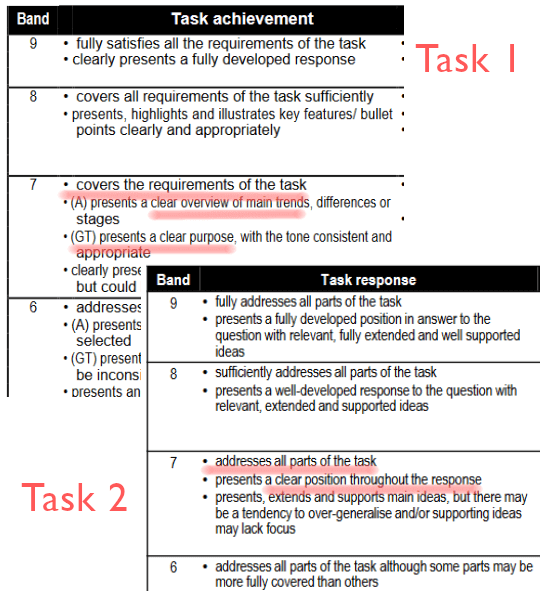
Task Achievement (TA) is how well the question is answered. If all parts of the question are dealt with and the ideas are logical or the data is accurate and well summarized, then TA will be high.
Coherence and Cohesion (CC) is how well structured the answer is, and if ideas are signaled and logically follow on from one another in paragraphs. Referencing and substitution are also important for good CC so the candidate doesn’t repeat the same things too many times.
Lexical Resource (LR) is the range of vocabulary a candidate uses. The wider the range of vocabulary a candidate uses to accurately express themselves, then the higher their band score will be. Spelling and word formation are also important for good LR.
Grammatical Range and Accuracy (GRA) will receive a high band score if the candidate uses lots of complex sentences with few errors. Complex sentences are sentences that have subordinate clauses such as relative clauses. Punctuation, using full stops and commas accurately, is also important for GRA.
IELTS General Training Writing Task 2 Scoring
In the Writing Task 2, an examiner will give you a score for each of these four criteria:
Task Response (TR) is the extent to which the test taker addresses all parts of the task, presents a clear position throughout the response and develops and supports ideas with relevant examples and explanations
Coherence and Cohesion (CC) is how well structured the answer is, and if ideas are signaled and logically follow on from one another in paragraphs. Referencing and substitution are also important for good CC so the candidate doesn’t repeat the same things too many times.
Lexical Resource (LR) is the range of vocabulary a candidate uses. The wider the range of vocabulary a candidate uses to accurately express themselves, then the higher their band score will be. Spelling and word formation are also important for good LR.
Grammatical Range and Accuracy (GRA) will receive a high band score if the candidate uses lots of complex sentences with few errors. Complex sentences are sentences that have subordinate clauses such as relative clauses. Punctuation, using full stops and commas accurately, is also important for GRA.
Important
- The final score you receive for the IELTS General Writing section is an average of the four criteria from both the Writing Task 1 and Writing Task 2.
- Writing Task 2 is longer (40 minutes) compared to Writing Task 1 (20 minutes), and, as such, has twice the weight of Writing Task 1.
The public band descriptors for Task 1 and Task 2 are provided below.
IELTS General Writing Band Descriptors
What is the Key Difference between General Training Writing Task 1 and 2 Descriptors?
Notice for the Task 2 descriptors, that Task Achievement has been replaced with Task Response, as the purpose of the task (to write a well-organized and relevant essay) is different to Task 1.
For Task 2, you can see that ‘a clear position’ (the writer’s opinion) is important. Therefore, the achieve the higher bands, the arguments must be relevant and fully developed. That means that you need to think carefully about how you support your main points.