
What are Modal Verbs
Modal verbs are auxiliary verbs that express conditions such as possibility, ability, necessity, and permission.
All modal verbs are auxiliary verbs, which means they can only be used with a main verb. In other words, modal verbs cannot be the main verb.
The modal verbs are: will, would, shall, should, can, could, may, might, and must.
In this module, we will focus on should, could, and would.
Let's begin with should.
1. Modal Verbs - Should / Shouldn't
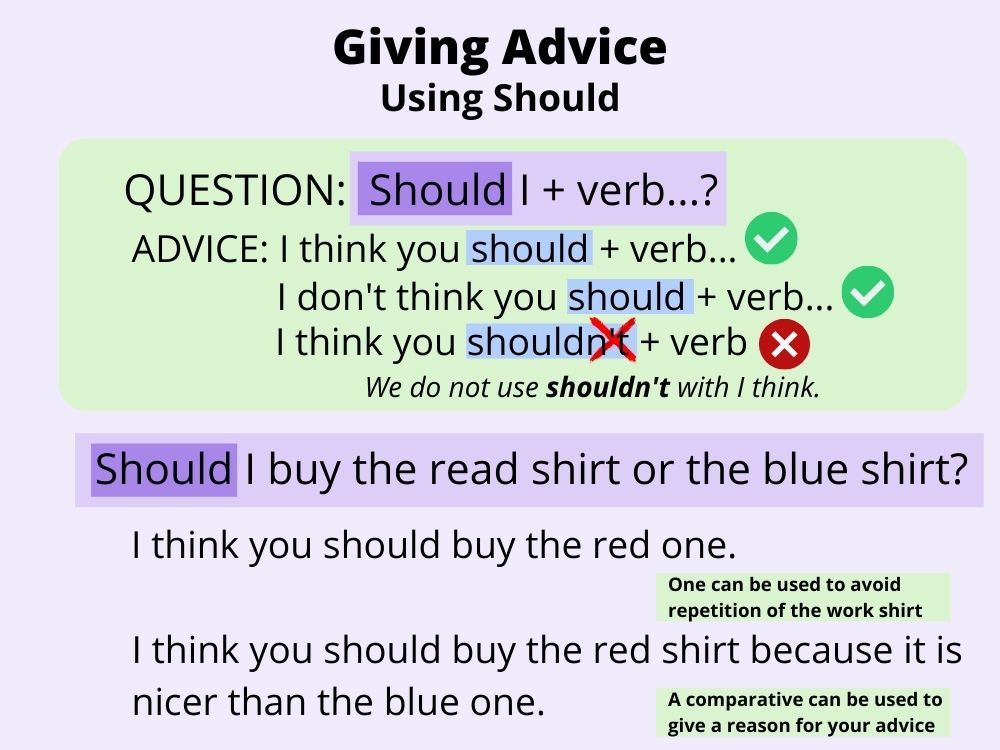
We use Should and Shouldn't for Advice.
Examples
A: “I’ve had a really bad headache for the past week.”
B: “That’s not good – you should go to the doctor.”
A: “I want to make more friends, but I don’t know how.”
B: “First of all, you shouldn’t spend so much time on the computer. You should go out and join a club or start playing a sport instead!”
A: “I had a fight with my best friend. What should I do?”
B: “Hmm… I think you should call her and tell her you’re sorry."
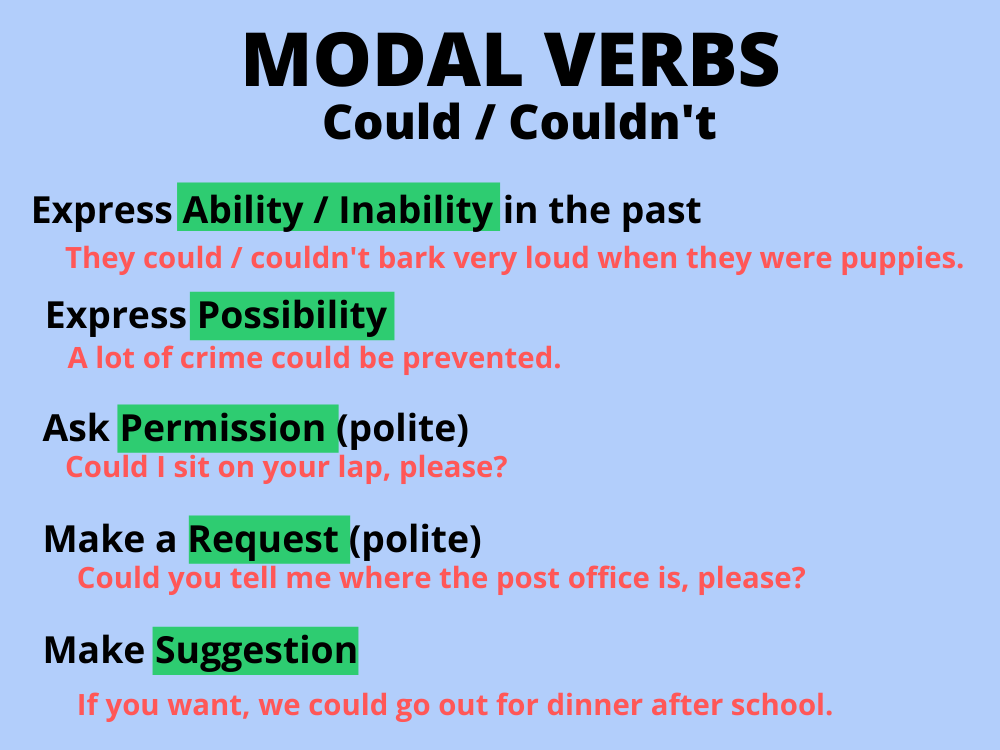
2. Modal Verbs - Could / Couldn't
The difference between should, could, and would is difficult for many English learners – this lesson will continue to help you understand when to use each one!
Notes
A: “Do you have any ideas for our publicity campaign?”
B: “Yes, I’ve got a few ideas. I could put advertisements on Facebook and Google. We could also give out pamphlets in our neighbourhood. Maybe John could even contact local TV stations.”
3) Use COULD to Make Polite Requests
- Could you please open the window? It’s hot in here.
- Could you turn the music down? Thanks.
- Could you make 10 copies of this report, please?
Exercise 8
Modal Verbs - Would
Use WOULD/WOULDN’T To Talk About Unreal Or Unlikely Situations
- If I were the president of my company, I would make a lot of changes.
- If people were more generous, there wouldn’t be so much poverty in the world today.
- She would travel around the world if she had more vacation time.
- If I were the president of my company, I’d make a lot of changes.
Use WOULD YOU LIKE To Make Polite Offers
- “A soda would be great. Thanks!”
- “I’d love to, but I actually have other plans tonight.”
Note: In this case, would is often shortened to ‘d