
In this lesson, you will look at how relative pronouns are used to introduce relative clauses which provide information about nouns and pronouns in a sentence.
The most common subject relative pronouns are who, whom, whose, which, and that. To become more familiar with these relative pronouns, let's start by reviewing the following infographic:
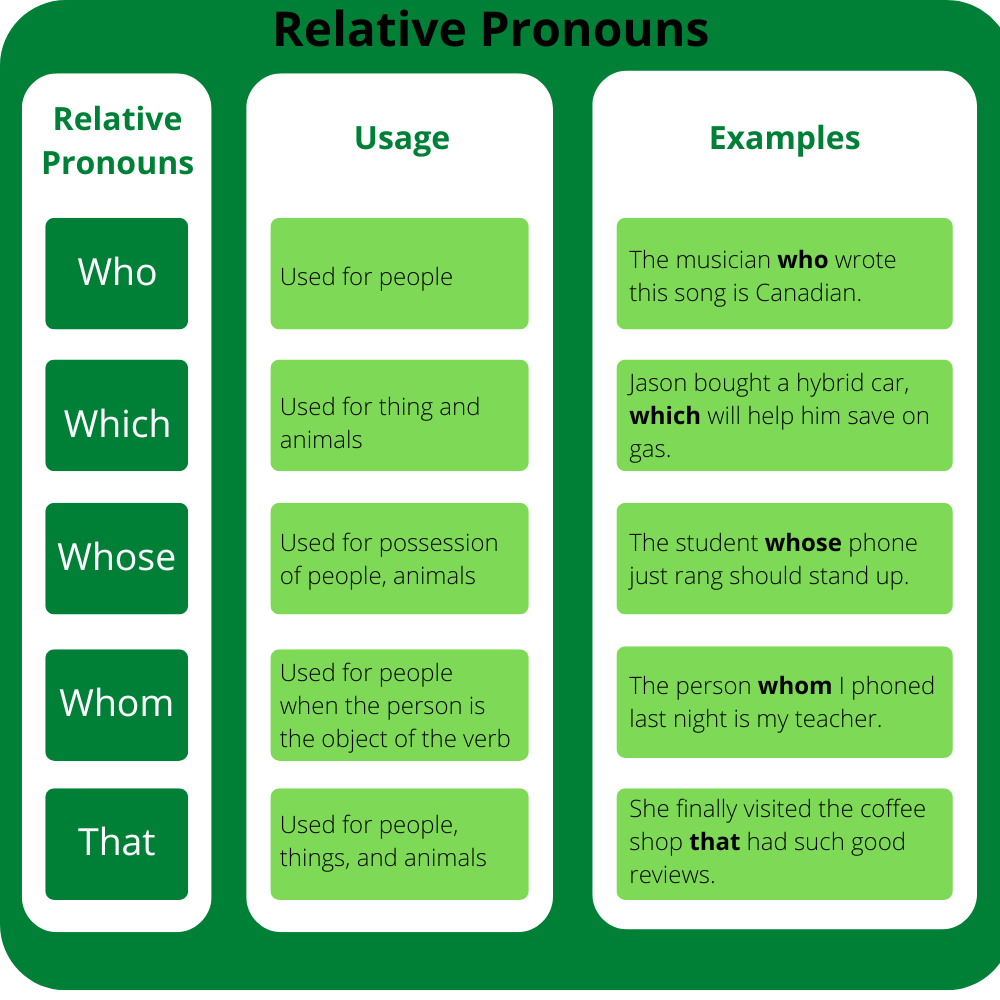
As you can see in the graphic, relative pronouns allow you to define, describe, identify, or give more information about nouns. As shown in the following example, the part of the sentence that comes after the noun is called a relative clause:

Exercise 3
Choose the correct relative pronoun for each sentence.
Avoid Common Mistakes
When you determine whether to use who or that, keep these simple guidelines in mind:
- Who always used to refer to people.
- That is always used when talking about inanimate objects (that computer, that piece of paper…)
- That can also be used when talking about a class or type of person, such as “that” team.